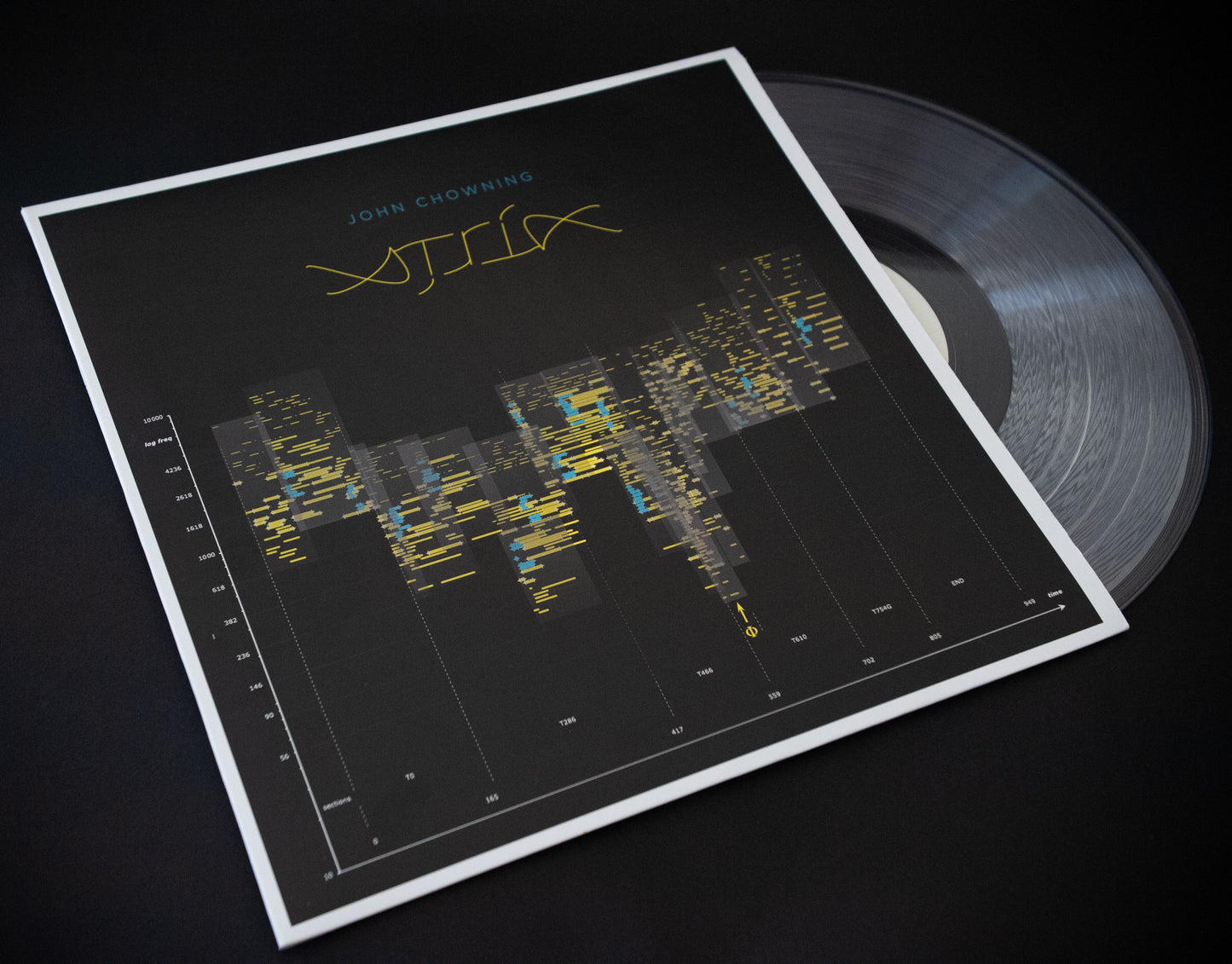
John Chowning - Stria - LP
John Chowning - Stria - LP
Couldn't load pickup availability
Share
Release date: Feb 27, 2026
Dr. John Chowning (b. 1934) is a pioneering computer musician, composer and professor who, in 1967, discovered the original FM synthesis technique. This breakthrough in electronic music allowed for simple, yet rich timbres described as sounding "real." With this discovery, Chowning composed singular, dramatic electronic music and changed the timbre of music forever. (more info below Soundcloud link)
Chowning utilized the potential of computers to synthesize sounds according to programmed instructions. The composer's use of his own FM algorithms, digital synthesis with computers and the new compositional concepts offered by a programmable musical structure combine to create some of the most original and unique electronic music ever created.
The compositions on this LP were realized between 1966 and 1981 and the music on this LP, with the exception of Stria, was originally released on CD in Germany (Wergo, 1988). The version of Stria included here contains a section not included on the Wergo CD. Thus, this version of Stria is complete. This is the first time these purely digital recordings have been released on an analog medium. The original dynamics of these groundbreaking compositions have been preserved on this LP. As a result, listeners are advised to increase volume with caution.
In 1975, John Chowning founded the CCRMA - Center For Computer Research In Music and Acoustics at Stanford University. Through Stanford, Chowning licensed his groundbreaking algorithms to Yamaha resulting in numerous new instruments including the iconic DX series of keyboards. In 1972, his composition Turenas which is included on this LP, was the first to create the illusion of continuous 360-degree space using four speakers.
Technical Notes
All pieces on this LP are originally quadrophonic. The illusion of moving sound sources is thus projected from the surrounding environment given by four loud-speakers on the stereo-basis.
STRIA was composed using Chowning’s own program to compile the musical structure into note-lists and MUSIC 10 (by D. Poole/Tovar) to generate the sounds in software-synthesis. The original quadrophonic version utilized 12 bits, two different sampling rates being used to accommodate the enormous amount of data on the magnetic disc-packs available at that time. The original sound-data was processed by sampling-rate conversion and digital mixes to achieve the stereo version presented on this CD.
SABELITH and TURENAS were synthesized originally using Smiths’ SCORE and MUSIC 10. However, their format was changed from direct sound-samples to a command stream for a special purpose computer, the System Concepts Digital Synthesizer, designed by Peter Samson, one of the first large-scale digital synthesizers for real-time sound processing - one was designed for CCRMA in the late seventies. For this recording the sounds were recorded directly from the synthesizer computing the samples in real-time.
PHONE was realized with the System Concepts Digital Synthesizer using again Chowning’s own program to create the note list.
The master tape of this CD was made directly from the computer system at CCRMA which generated and stored the sound data in digital format. No analog recording was involved at any stage of the production and editing process.
JOHN M. CHOWNING was born n Salem, New Jersey, in 1934. He studied composition in Paris for thee years with Nadia Boulanger. In 1966 he received the doctorate in composition from Stanford University, where he studied with Leland Smith. With the help of Max Mathews of Bell Telephone Laboratories and David Poole of Stanford in 1964 he set up a computer music program using the computer system of Stanford’s Artificial Intelligence Laboratory. This was the first implementation of an on-line computer music system ever.
In 1967, John Chowning discovered the frequency modulation (FM) algorithm in which both carrier-frequency and the modulating-frequency are within the audio band. This breakthrough in the synthesis of timbres allowed a very simple yet elegant way of creating and controlling time-varying spectra.
Over the next six years he worked toward turning this discovery into a system of musical importance. In 1973, he and Stanford University bean a relationship with Yamaha (Nippon Gakki) in Japan, which led to the most successful synthesizer series in the history of electronic musical instruments.
John Chowning has received fellowship grants from the National Endowment for the Arts and was artist-in-residence with the Kunstlerprogramm des Deutschen Akademischen Austauschdiensts for the City of Berlin in 1974, and guest artist in IRCAM in 1978-79, in 1981 and in 1985.
John Chowning currently teaches computer-sound synthesis and composition at Stanford’s Department of Music and is director of the Center for Computer Research in Music and Acoustics (CCRMA), one of the world’s leading centers for computer music and related research in the world.
PHONE
The sounds in Phone (from the Greek, meaning “sound” or “voice”) were produced using a special configuration of the frequency modulations (FM) synthesis technique which allows the composer to simulate a wide range of timbres including the singing voice and other strongly resonant instrumental sounds. The synthesis programs are designed to permit exploration of and control over the ambiguities which can arise in the perception and identification of the sound sources. The interpolation between timbres and extension of “real” timbres into registers which could not possibly exist in the “real” world - such as a “basso-profundissimo” -, the micro structural control of sound having to do with the fusion or segregation of spectral components are some of the points of departure for this composition. - John Chowning developed this new technique of FM synthesis at IRCAM, Paris, in 1979 and realized the piece at Stanford in 1980-81. The work was premiered in Paris in February of 1981.
TURENAS
Turenas (1972) was the first widely presented composition ever to make extensive use of frequency modulation (FM). At the same time it was the first piece to create the impression of moving sound sources in a 360 degree sound space. Chowning developed a technique for synthesizing any path a sound could follow moving around or through the audience surrounded by just four loudspeakers. By means of the computer it is possible to calculate the Doppler shift, the angle, and distance as the sound “moves” from one place to the other in an illusory space. The title TURENAS is an anagram of “Natures” thus pointing to the issues Chowning addresses in this piece, namely the question of how to apply the knowledge gained in the understanding of the attributes of natural sounds to a compositional goal.
STRIA
Due to a transcribing error, the version of Stria on the original Wergo CD is incorrect. It is this version that was intended.
The composition takes advantage of certain features of the FM algorithm which made it possible to integrate a non-tonal division of the pitch space and the ratio of inharmonic (non-harmonic) spectral components, timbre space. The sounds are governed by the Golden Ratio, 1:𝚽 = 1:1.618..., which determines the timbre (the structure of the partials), the ratio of the pseudo-octaves, powers of 𝚽 rather than powers of 2, and the overall form of the piece. Thus, the sounds were not composed simply as spectra determining timbre, but in a complimentary relationship to the pitch space. This inharmonic relationship of simultaneously sounding pitches yields a transparency and order in what would normally be considered to be "clangorous" sounds.
STRIA was commissioned by the Institut de Recherche et de Coordination Acoustique/Musique (IRCAM), Paris, and premiered at the Centre Pompidou, October 13, 1977.
SABELITHE
Chownign began a first version of SABELITH in 1966. As the computers of the Artificial Intelligence Lab he was using at that time were disconnected and moved to a different location, he was not able to finish the piece as planned for three performers and computer generated tape. In 1971 he composed a second version for computer alone. As there was not enough memory available back then to contain all the samples of the whole piece it had to be spliced together on analog tape. For the production of this disc the old sample data of the composition had to be recovered from “ancient” disc-packs stored in dusty attics; then the old data had to be rewritten to be compatible with the current system at CCRMA. This work, written a few months before TURENAS, was the first ever to use FM synthesis. A pivotal point of the piece occurs when a snare-drum like sound gradually changes into a trumet like sound as a result of interpolation rather than cross-fading from one timbre to another.